
Anchored in Community and Finding Self: Reflections from IEP Summit 2026
Sometimes, you attend a conference hoping to learn something new, discover a few tools, meet people in your profession and perhaps return with some ideas to implement. And sometimes, you come away with something much more valuable – an affirmation of the journey you have already travelled, the choices you have made, and the professional identity you have been slowly building for yourself.
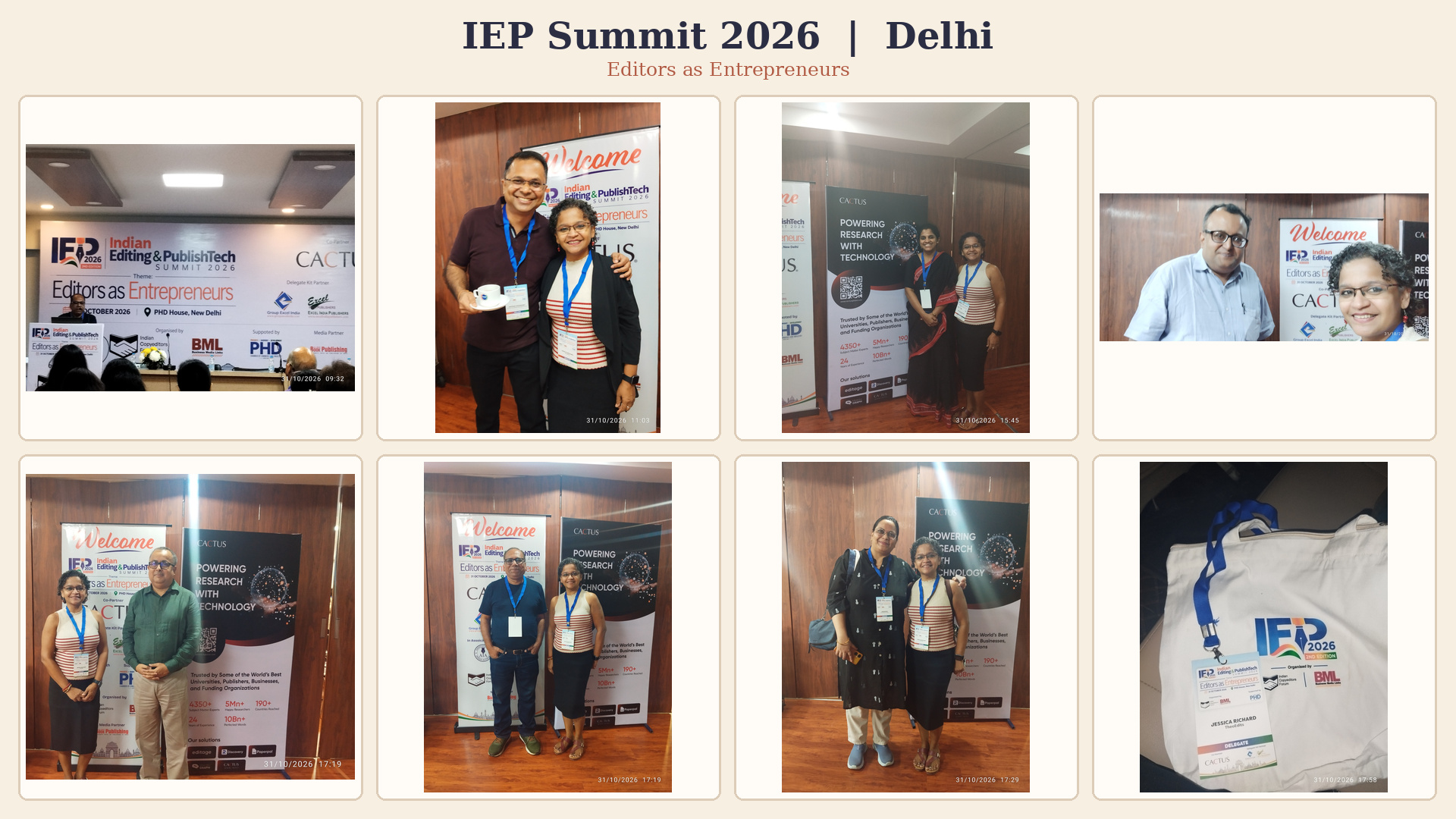
That was my experience at the Indian Editing and PublishTech Summit #IEPSummit2026 in Delhi on 31 October 2026. Organised by the Indian Copyeditors Forum (ICF), the summit brought together editors, publishing professionals and people working at the intersection of editing and technology around the theme Editors as Entrepreneurs.
I went with an eagerness to learn, but I came back with a renewed appreciation of my own journey with TheoEdits, my editing business, and a much stronger sense of what it means to call myself an editor and an entrepreneur.
It took me a little while to arrive at that last bit. Seven years of running TheoEdits, and over two decades of working as an editor, have brought me to a point where I can finally say this with a certain degree of confidence and even pride: I am an editor, and I am an entrepreneur. The two are not mutually exclusive.
Beyond editing: Recognising the entrepreneur in me
One of the opening sessions, Beyond Editing – Re-evaluating the Entrepreneur in You, by Vivek Mehra, got me thinking about what makes a client choose a human editor over automation. It is a question that is becoming increasingly important in the age of AI. What is it that we bring to the table that a machine cannot quite replicate? How do we articulate that value to a client?
The discussion around diversifying our services, identifying what else we know and recognising where our skills could be useful was particularly relevant. Entrepreneurship, as I understood from the session, is also about looking at the market, understanding the skills and experience we already possess, and finding ways to translate these into services that address a need. It is not necessarily about acquiring an entirely new skill or setting up something completely different.
This resonated with my own journey. TheoEdits began as an editing enterprise, but the professional work I have undertaken over the years has never been confined to copyediting alone. My experience in project management responsibilities for large, multi-author publication projects, and my work in the development and advocacy sector and leading a nationwide network, contributing to the women’s movement, child rights movement and disability advocacy movements in India, evaluating developmental projects of faith-based organisations, and serving on boards, advisory committees and core groups of various organisations and communions – are various pathways in my career that have ridden on the back of the principles in the craft of copyediting.
These may seem like different professional spaces, but there is a thread that connects them. The ability to work with content, people, ideas, systems and processes; to pay attention to detail while holding the larger picture in view; to communicate, coordinate and bring people together around a shared purpose. Editing has given me a particular set of skills, but those skills have travelled with me into other spaces.
Dr Pallavi Narayanan’s session on how the editor’s role is changing brought this into sharper focus. She spoke about moving beyond the traditional understanding of editing into roles that involve developing, advising and connecting. The question she posed – What problems do I know how to solve? – is perhaps a much more useful starting point for thinking about our entrepreneurial offering than simply listing the services we provide.
It also made me think about how much of our work as editors is invisible, and how important it is to make that work visible to clients. What exactly are we offering? Who is it for? What problem does it solve? What is the deliverable? These are questions that require us to think of ourselves not merely as people who undertake an editing assignment, but as professionals who offer a service and take responsibility for its outcomes.
The craft of editing: Some things never change
Amid all the conversations about technology, AI and the changing publishing landscape, one of the sessions that I particularly appreciated was Shantanu Ray Chaudhuri’s What Editing Entails?
There was something reassuring about listening to someone articulate so clearly the principles that have guided my own copyediting practice over the years. Small errors can have large consequences. When copyediting is done well, it is almost invisible; the book belongs to the author, and the editor’s work should not draw attention to itself. But when an editor misses something, it can become the most jarring part of the reading experience.
His description of copyediting as the protection of meaning stayed with me. So did the reminder that we must serve the text without taking it over.
I have always believed that editing is not about imposing my own preferences on an author’s writing. It is about understanding what the author is trying to say, recognising the intended audience, and making decisions that preserve meaning and voice. As Shantanu so profoundly pointed out, one must learn to distinguish between an error and a choice. Not everything that looks unfamiliar or different is necessarily wrong, and not every sentence needs to be rewritten to sound like the editor.
The session’s emphasis on accuracy, consistency and attention, and the importance of the tone of editorial queries, were reminders of the intellectual and relational dimensions of our work. A copyeditor asks the right questions of the text. This requires forensic reading, discipline and a healthy degree of scepticism. It also requires tact, because the way we raise a query matters just as much as the query itself.
I particularly liked the phrase intellectual stewardship to describe copyediting. It captures something I have tried to practise throughout my editing journey. Our job is not to display how clever we are or how much we know about grammar and language. It is to make the author’s work better while allowing the author to remain visible.
After more than twenty years in this craft, it was gratifying to hear these principles articulated so well. It reminded me that experience matters, and that the seemingly small decisions we make on every page are grounded in considerable knowledge, judgement and care.
AI, technology and knowing what makes me valuable
It would have been impossible to attend a publishing summit in 2026 without AI becoming a significant part of the conversation. Several sessions explored how AI is changing the editing landscape, and Mohit Odhikarry’s session on how copyeditors can use AI was particularly useful.
The message was not to keep fighting AI, but to learn how to use it to enhance what we do. There is no denying that AI can take care of some repetitive tasks, including reference checking, formatting and aspects of consistency checking. It can also help editors build workflows, create tools and automate tasks that would otherwise consume considerable time.
But one question that I came away with from the session was: why would I train AI to do something that is my unique selling proposition? And this is a question worth sitting with and processing for my own positioning of TheoEdits as I go forward.
I believe we need to understand our own USP before deciding which aspects of our work we should hand over to technology. AI can help with speed and efficiency, but it does not remove the need for human judgement, critical thinking, contextual understanding and an appreciation of nuance. In fact, it makes these abilities even more important.
Namrata Dave’s session on the future of editing brought together the human and technological dimensions through what she called the EDITS framework: Evidence, Decisions, Intent, Tact and Stakes. I found this a useful way of thinking about the responsibilities of an editor. We verify information, own our editorial decisions, understand the author’s intent, communicate with tact and remain conscious of what is at stake in the text we are working on.
The distinction between using technology to support our work and allowing it to replace our judgement was an important one. I was also introduced to several tools across the three areas of delivering editorial work, growing our services and running our businesses. Some were familiar, while others have gone onto my list of tools to explore.
I came away particularly interested in learning more about Microsoft Copilot, exploring some of the accessibility-related tools, and understanding how AI could be used to develop more efficient workflows. Certifications also featured in this conversation, and I found myself thinking again about my own plans to explore professional certifications as a way of strengthening and formally validating my experience.
What I appreciated most was that the discussion did not suggest that technology makes the human editor redundant. Rather, it challenged us to become more intentional about where we invest our time and expertise. Efficiency is not the same as judgement. That is something I want to keep reminding myself of.
Seven years of TheoEdits: Learning to value my work
One of the most personally affirming sessions for me was Anupam Choudhury’s session on what editors should charge for their services.
I have been using Anupam’s gig-rate calculator since I started TheoEdits. It was genuinely a game-changer for me because it helped me move away from the rather uncomfortable exercise of guessing what I should charge, or comparing my rates with what someone else might be charging. It gave me a framework for understanding the relationship between my time, the cost of running my business, my earning requirements and the value of the service I offer.
Listening to Anupam speak about pricing, time, capacity utilisation, inflation, rush rates and the importance of taking money seriously was an affirmation of the financial systems I have been building for TheoEdits.
Running an editing business is not simply about being good at editing and finding clients. There is an entire business operation behind every assignment. We have to understand our costs, estimate the time required, manage our capacity, invoice correctly, follow up on payments and navigate the financial complexities of working with clients across countries.
Managing international clients also brings its own challenges, particularly when it comes to cross-border payments, currency conversions, inward remittances, taxation and international invoicing conventions. Abha Agarwal’s and Gina Malkhani’s experiences, shared in the session on navigating the journey from the first gig to global clients, brought out some of these realities.
I was glad to recognise that I have already invested considerable time in researching and learning about these aspects of running TheoEdits. Much of what was discussed was not entirely new to me. I have spent years figuring out the systems that work for my business, understanding the requirements of international transactions and establishing processes for invoicing and financial documentation. It has involved a fair amount of self-learning, research and sometimes trial and error.
The summit reassured me that I am on the right track.
There was also a practical reminder that we should not be apologetic about charging for our services. Editing is a service, not a commodity, and the time and expertise we bring to it have value. We need to know what we need to earn, what we can realistically charge, and what we uniquely offer a client. We also need to understand that pricing is connected to the quality and value of the service we provide.
I found the suggestion of looking at bundled services interesting too. Copyediting with reference checking, copyediting with indexing, or combining editorial work with workshops and other services can create more comprehensive offerings for clients.
For me, this session was not just about calculating rates. It was about recognising that I have been learning to run a business, not simply accepting editing assignments and sending out invoices. There is a difference, and I am beginning to appreciate how far I have come.
The editor’s work does not end with the edited manuscript
Another interesting perspective came from KP Eashwar’s session, Content: Product or Impact? An Editor’s Perspective.
The progression from content to product to impact was particularly thought-provoking. As editors, we tend to focus on the manuscript or document in front of us. We are concerned about the quality of the content, whether it communicates what it intends to, whether the references are accurate and whether the final product meets the required standards.
But what happens after the product is delivered? Where does the content go? Who reads it? What difference does it make? Does it contribute to a larger conversation, influence policy, help an organisation secure funding or make a difference to a community?
These questions take us beyond the immediate editorial assignment and into the larger purpose of the work.
This resonated with me because much of my professional life outside TheoEdits has involved working with content that is intended to create change. In the development sector, publications, reports, evaluations, advocacy documents and resource materials are not merely products to be completed. They are meant to inform decisions, influence practice and contribute to social transformation.
Having worked across editing, development and advocacy spaces, I find that I cannot always separate the quality of a publication from the purpose it is meant to serve. Understanding the subject, its context and its intended impact is part of what makes an editor valuable.
It also reminded me that our professional growth need not be measured only by how many pages we edit in a day or how quickly we complete an assignment. There is a larger question of whether the work we do adds value and contributes to something meaningful.
The business behind the craft
Something else that emerged across the summit was the importance of building systems around our work.
Dola Basu’s experience of running her one-woman business, Shiuli, and her reflections on the role of a website were particularly relevant. A website is not simply an online business card. It is a space where we can present our work, communicate our approach, showcase our skills and allow potential clients to understand what we offer. A well-maintained website and the content we publish can continue to work for us even when we are not actively looking for clients.
That struck a chord with me. Like Dola Basu, I created my own website and I have invested in building TheoEdits as a professional identity, and I recognise the importance of the website as a space that I own and control, where I can communicate my work and the kind of editorial practice I believe in. It also made me think about the possibilities of developing the writing side of my work alongside editing.
The summit also offered practical reminders about professional networks, contracts, client research, protecting our professional identity and not relying entirely on word of mouth to build a business. These are not glamorous aspects of entrepreneurship, but they are essential.
There was also an interesting emphasis on certifications as a way of building credibility. In a professional environment where clients have many choices, and where automated tools can produce outputs that look superficially convincing, being able to demonstrate one’s competence becomes increasingly important. I have been considering exploring certifications for some time, and the conversations at the summit reinforced that this is a worthwhile direction to pursue.
I returned with several things to explore, but also with the satisfaction of knowing that I have already put many of these systems in place, often through my own research and learning.
ICF: More than a professional forum
And then, of course, there was the community.
The Indian Copyeditors Forum #ICF has been part of my professional life since 2017. Over these years, it has been a space for learning, exchanging ideas, asking questions, sharing opportunities and growing alongside other editors. Many of the people I met in Delhi were people I had known through online interactions and chats for years, but had never actually met in person.
Meeting some of them physically for the first time after nine years of being friends was perhaps one of the most delightful parts of the summit. There is something quite special about finally putting faces to names and voices, and discovering that the camaraderie you have experienced online translates so naturally into in-person conversations.
For those of us who work independently, often from our homes and with clients and collaborators scattered across the world, professional community matters. It can be a source of learning, encouragement, solidarity and opportunity. ICF has been that kind of community for me, and the summit was another reminder of why professional networks are worth investing in, and why such friendships keep us grounded.
The trip from Chennai to Delhi was well worth it.
Coming home with a renewed sense of purpose
I returned from the IEP Summit with a notebook full of notes, a list of tools to explore, ideas for professional development and several things I want to work on in the coming months. But perhaps the most important thing I brought back was a renewed sense of confidence in what I have built.
For a long time, I think I saw TheoEdits primarily through the lens of the editing assignments I undertook. I was an editor who ran a small business. I was focused on doing good work, building relationships with clients, learning the financial and operational aspects of the business and finding ways to sustain it.
I now realise that all of these are part of being an entrepreneur. The fact that TheoEdits is not a large company, or that I operate independently, does not make that any less true.
Entrepreneurship has involved learning to value my work, establish boundaries, build systems, identify opportunities, develop new skills, manage projects and take responsibility for the sustainability of what I have built. It has also meant learning to recognise the many ways in which my skills and experience can be useful beyond the immediate task of editing a manuscript.
Seven years is not a particularly long time in the life of a business, but it is long enough to have learnt a few things, made mistakes, found my footing and developed a sense of what I want TheoEdits to become.
I am still learning. There are tools I want to explore, certifications I want to pursue, systems I want to improve and new possibilities I want to consider. I do not have everything figured out, and perhaps that is part of the journey.
But I came away from Delhi feeling that I do not need to constantly question whether I am doing enough or whether I belong in the space of editorial entrepreneurship. I have been doing the work, often quietly and largely through self-learning, for several years now.
The IEP Summit gave me an opportunity to see that work reflected in the experiences and insights of others in the profession. It helped me recognise that many of the principles I have been following are sound, that my understanding of the craft has a strong foundation, and that I have much more to offer than the editing services I provide.
Most importantly, it helped me own a title that I have taken some time to grow into.
I am an editor. I am an entrepreneur. And I am quite happy to finally say both with pride.

